The Cilento Secret, Oct. 18-25, 2026
The journey begins in Naples at 2 pm.
We drive south together on what locals call the mozzarella highway, through Battipaglia, past roadside signs flashing "mozzarella di bufala".
We'll keep going farther south to Capaccio-Paestum, where the best buffalo farms in the world sit within walking distance of Greek temples that have stood for nearly three thousand years.
This is where the story begins...
Host
Danielle Oteri
This week is the living experience of Episode 35: The Mozzarella Highway. Danielle Oteri will be your host for the week, with visits and tours led by her friends and collaborators.
During lunches and dinners together, the group will have conversations about art, history, and ideas inspired by your explorations of the Cilento Coast.

The Cilento Secret Itinerary
"I know I come from paradise," our boat captain said, "and I only want to stay here and share this with others."

Day 1
Benvenuti al Sud
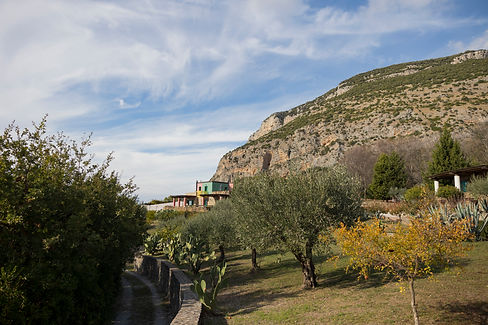
By the time we arrive at Borgo La Pietraia in the late afternoon, you will already understand why traveling to the lesser-known places in Italy is so rewarding.
Welcome aperitivo on the terrace as the sun drops into the Tyrrhenian. Dinner is a tasting menu built entirely from what is local and fresh in October, which is a lot.
Day 2
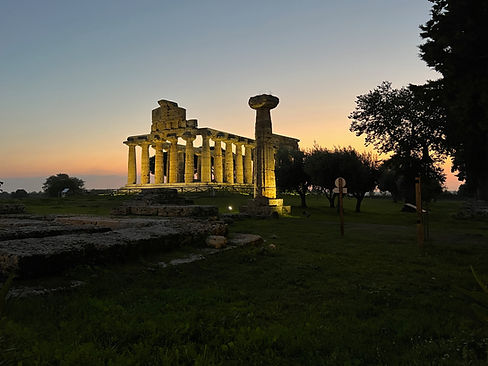
The buffalo farm and the Paestum temples
We return to Paestum properly, stopping first at a farm where mozzarella is made the way it has been made in this landscape for centuries, from buffalo milk, by hand, and eaten while still warm. The buffalo here are unhurried and enormous, moving through the morning with a quiet authority that makes sense once you understand their history. They are not merely photogenic. They built this landscape. It was buffalo that cleared the rivers and drained the swamps, and it was buffalo that dragged the Roman columns out of the ruins of Paestum and carried them to Salerno to build a Norman cathedral. They have been working in this corner of Italy for a thousand years, and the mozzarella they produce within walking distance of the oldest Greek temples on the Italian peninsula is, as far as I am concerned, the best in the world.
Then we walk to the temples.
The three Greek temples at Paestum are among the best preserved anywhere, better than anything standing in Greece itself. The oldest was already 280 years old when the Romans arrived, which means it was considered ancient in antiquity. We visit with guides who know what the recent excavations have revealed, discoveries that are actively changing what archaeologists understand about this colony and its relationship to the Greek world. The temples you leave will look completely different from the temples you entered.

Day 3
Salerno
In 1077 the Normans conquered Salerno. They were proud descendants of the same Vikings who, eleven years earlier, had taken England at the Battle of Hastings, and they made the city a center of international trade, home to the world's first medical school. To build the cathedral of Saint Matthew the Apostle, and to make the architectural argument that this northern power was the legitimate heir to Rome, they needed Roman columns. They got them from Paestum, dragged them through the swamp by the same water buffalo you visited yesterday, and carried them up the coast to Salerno, where they still stand in the courtyard of the Duomo today.
We spend the morning with a guide who knows this story and its meaning. If you walk the streets of the centro storico and see a sign that reads "Questa è storia" with a red line through a dog lifting its leg, you are standing next to one of those columns. The afternoon is yours to explore one of the most under-visited historic centers in Southern Italy, with excellent small shops, antiquarians, and streets that reward slow walking. There is also, if you know where to look, the only hat maker left in all of Italy.
Day 4
Cilento Villages
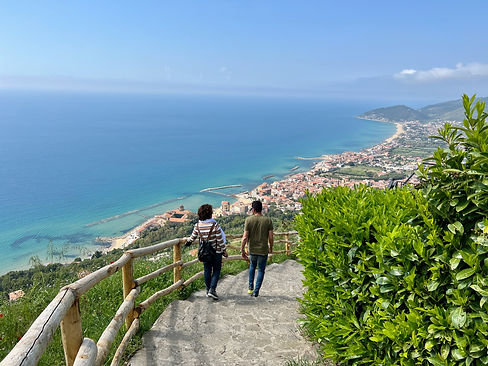
A day that moves between the clifftop villages of the southern Cilento coast and a visit to Santomiele, where the white figs of Cilento are transformed into something that belongs in a different category of food entirely. Figs stuffed with nuts, coated in chocolate, packaged with the kind of care that makes you understand you are holding something specific to this soil and this light and nowhere else. They are imported to the United States by a company in the Bronx, which is its own little story. We will eat them where they are made, in a showroom in the middle of a national park that is one of the most unexpected and beautiful places I know in Southern Italy.
In the afternoon, we'll move to another part of this beautiful village for a wine tasting to discover the grape called Aglianicone, the very first grape the Greeks brought with them to Italy.
Day 5
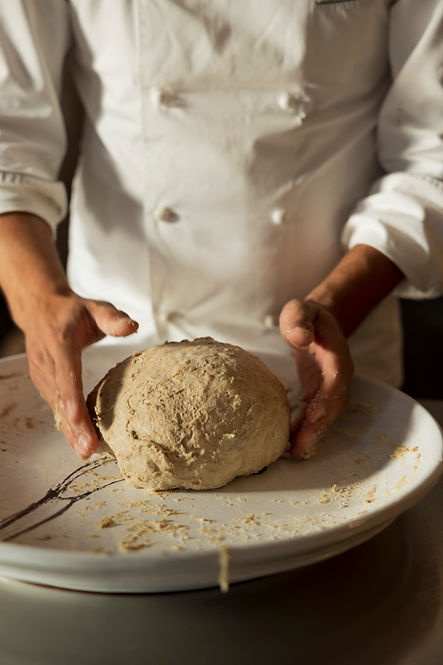
Breadmaking with Chef Mario & Nonna Angela
One morning with Nonna Angela, Chef Mario's grandmother, learning to make bread. Mario did not go to culinary school. He learned to cook from his grandmother, and the bread she makes carries knowledge that does not exist in any cookbook and cannot be captured in a YouTube video. Mario will help explain her sense of when the dough is right, the wisdom of good digestion from pure products, and the patience one must give to process. These are things you can only learn by standing next to someone who learned them the same way.
After lunch, the afternoon is entirely yours. There is an optional visit to the Approdo Thalasso Spa for those who want it. The Cilento has a documented relationship with longevity, and the locals, when pressed, will tell you it has something to do with not being in a hurry. We are practicing that today.

Day 6
The Cape of Palinuro
Weather permitting, we sail around the Cape of Palinuro with the captain who grew up on these waters. The cape may be the most beautiful stretch of coastline in Italy, and it is almost certainly the least known. The sea caves here contain Neanderthal bones and tools, as well as evidence of a Paleolithic fishing village. You can swim from the boat to the Baia di Buon Dormire, the Bay of Good Sleep, which earned its name as the place where fishermen could nap and wake up with their nets full. It can only be reached from the water.
Somewhere beneath the surface, in waters our captain has sailed his entire life, underwater archaeology is underway that the Italian government has decided the public is not yet allowed to know about. We will talk about it on board.
We will also enter the Blue Grotto -- not the famous one in Capri which requires a pricey ticket and a reservation, but this one which is protected by the Cilento National Park, and is much larger.
The Palinuro boat day is subject to weather. If conditions require it, we will adjust the schedule around it. Even if it's not warm enough to swim, we can still proceed with the boat ride.
Day 7
The olive harvest
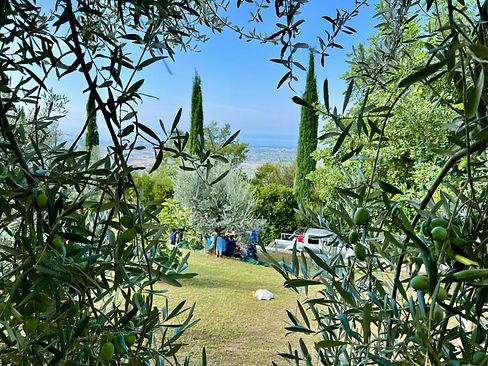
The olive groves at Borgo La Pietraia are in full harvest, and we will harvest and transform the olives into olive oil while we are there. You will join the people who tend them, learning to read the fruit, understanding why the timing of the harvest changes everything about the oil, tasting what has just been pressed.
We'll also go much higher into the Cilento National Park, to visit another olive farm, and have lunch on a terrace with a view that will take your breath away, amidst nature you will be glad isn't known to mass tourism.
There is no better last day in the Cilento than this one.
Day 8
Return to Naples
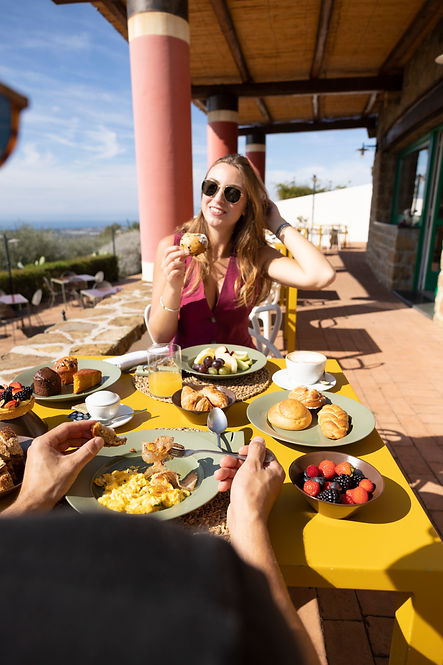
After one last breakfast on the terrace, your driver will return to the Naples train station. Transfers (other trains) should not be booked before 1 pm in case of traffic.
Details
Acommodations
Borgo La Pietraia has twelve suites, all with views of the Tyrrhenian Sea.
Junior suites — queen bed, full sea view, large terrace · 7 rooms available
Deluxe suites — queen bed, partial sea view, private terrace · 4 rooms available
Click here to learn more about Borgo La Pietraia
Pickup & Dropoff
Pickup at the Naples train statio at noon on October 18th and return to Naples train station on October 25th at noon.
If you need to transfer at another time, we can arrange it and bill you seperately.
Food & Wine
This trip includes all meals except for lunch in Salerno. Meals will include a mix of chef-prepared selections at the property as well as local restaurants.
The hotel has a breakfast buffet every morning, with eggs available to order.
Any food allergies or special diets must be shared ahead of time so we can plan accordingly.
Our Destination
This is the Cilento that doesn't have a guidebook. If you have been listening to the podcast and thinking that this is the kind of Italy you want to experience in person — this is the one.
Junior Suite Double Occupancy
$3,563 per person
Junior Suite Single Occupancy
$4,447 per person
Deluxe Suite Double Occupancy
$3,312 per person
Deluxe Suite Single Occupancy
$3,944 per person
Want to join?